
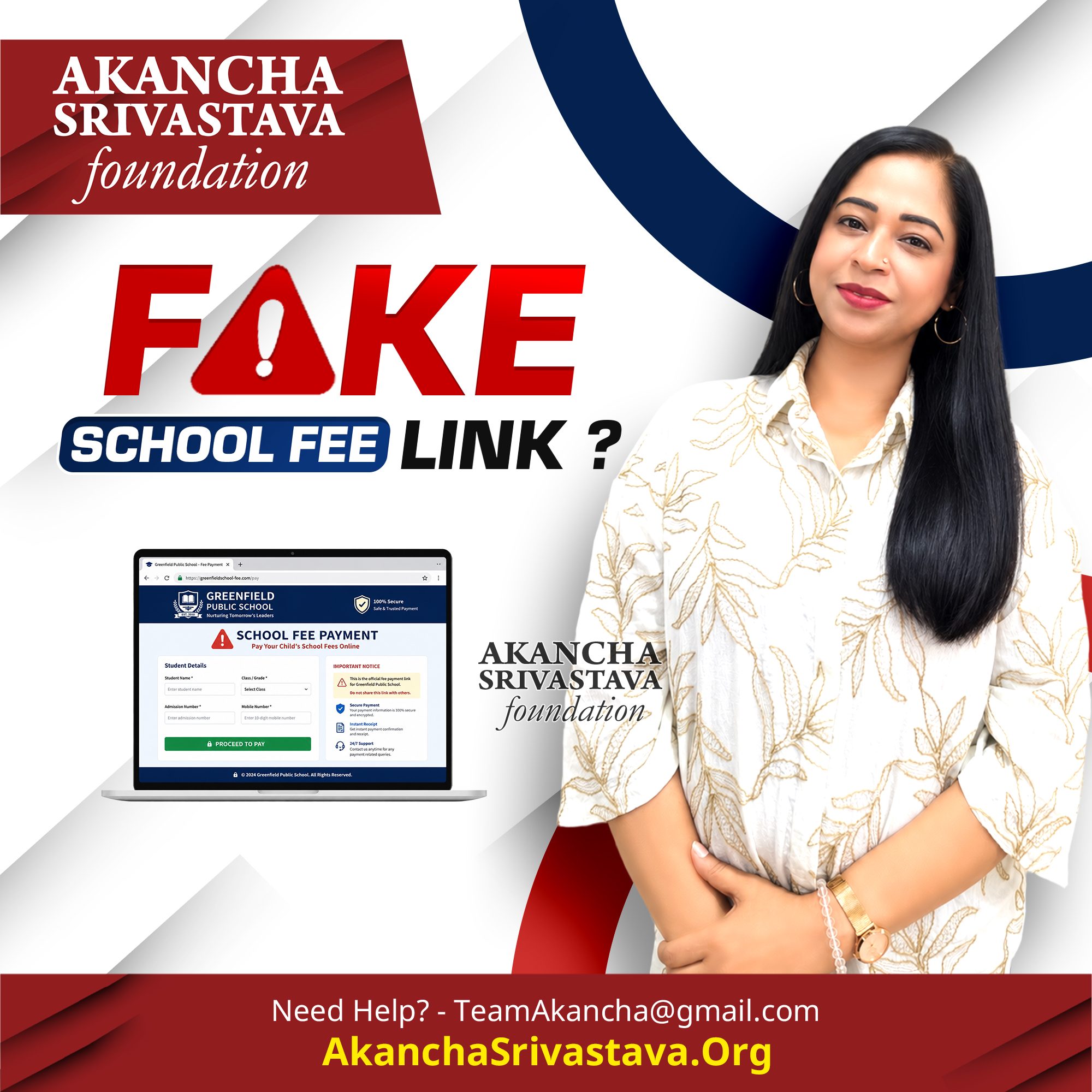
Parents are used to receiving school updates on WhatsApp, email, SMS, portals, and parent groups.
Fee reminders, circulars, transport notices, event payments, exam charges, book payments, uniform payments, and activity fees often come digitally now.
This convenience is exactly what scammers misuse.
A fake school fee message may look normal at first. It may carry the school name, logo, payment deadline, child’s class, fee amount, or a link that looks official. It may create urgency by saying “pay today”, “last date”, “late fee applies”, “seat may be blocked”, “transport service will stop”, or “exam form will not be processed.”
Many parents click because they are busy, worried, or trying to avoid delay. One wrong link can lead to payment fraud, credential theft, card misuse, UPI redirection, or account compromise.
Please remember this clearly: a school payment link received on WhatsApp or SMS must never be trusted automatically.
Parents must verify every payment request through the official school app, official website, school fee portal, or known school office number. Do not pay through random links shared in groups. Do not scan QR codes sent by unknown numbers. Do not enter card details, UPI PIN, OTP, net banking password, or parent portal credentials on unfamiliar pages.
Scammers may also impersonate school staff, class teachers, transport coordinators, accounts departments, PTA members, or other parents. They may create fake urgency around admissions, pending dues, transport fees, exam registration, school trips, or activity payments.
Before making any school-related payment, check the sender’s number, email domain, spelling, payment gateway, URL, and official fee record. Call the school office directly using the number saved from official records. Do not call numbers mentioned inside suspicious messages.
Parents should also speak to children. Children must not forward fee links, payment requests, QR codes, class group messages, or school notices without checking with parents. Older children using phones must understand that school-related messages can also be used for fraud.
If money has been paid through a fake link, immediately call 1930, contact your bank, freeze the transaction where possible, preserve screenshots, save the sender number, link, payment receipt, UPI ID, bank details, and file a cybercrime complaint.
A school message may look familiar, but familiarity is not verification. Before paying, pause and confirm through official school channels.
📢 Spread awareness, SHARE this video to protect users from online harm.
🔹 Follow for expert cyber safety insights from the Akancha Srivastava Foundation. Together, we build a safer online world.
🔔 Subscribe for more cyber safety insights.
👍 Like, share, and comment to spread awareness.
Stay Aware, Stay Safe.
Jai Hind, Jai Bharat.
CONTACT US:
Website: www.AkanchaSrivastava.Org
Email: TeamAkancha@gmail.com
Twitter: @AkanchaS
Instagram: @akanchas
https://www.instagram.com/akanchas/
Facebook:
https://www.facebook.com/akanchasrivastava1
LinkedIn:
https://www.linkedin.com/in/akanchasrivastava/
ABOUT ‘AKANCHA SRIVASTAVA FOUNDATION’
The Akancha Srivastava Foundation is India’s leading social impact initiative dedicated to advancing cyber safety awareness and education. Established in February 2017, this not-for-profit Section 8 organization is a trusted voice in promoting safe online practices across the nation.
Distinguished Board of Advisors
Guided by an honorary advisory board of esteemed leaders:
- Former Special DGP RK Vij (Chhattisgarh Police)
- ADG Navniet Sekera (Uttar Pradesh Police)
- ADG Krishna Prakash (Maharashtra Police)
- Dr. Poonam Verma (Principal, SSCBS, Delhi University)
Our Mission
The Foundation is committed to educating, empowering, and building bridges between the public and authorities on critical cyber safety issues. Additionally, we specialize in forensics training for law enforcement, equipping them with the skills needed to tackle cybercrime effectively.