
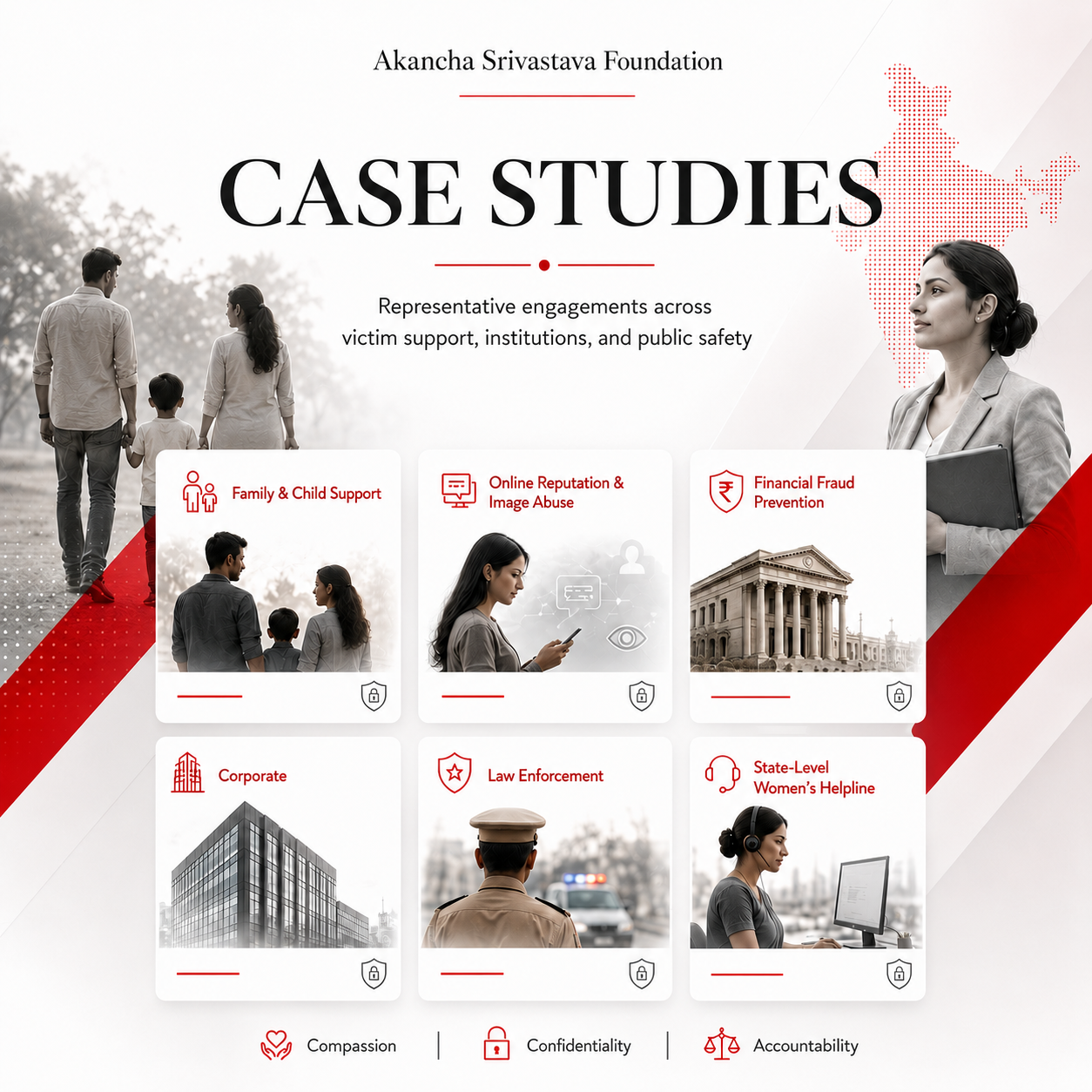
All engagements presented here are anonymised. Where cases involve individuals, families, or survivors, details have been changed or withheld to protect identity. No case is published without the awareness of the person or institution involved.
The foundation treats every disclosure as confidential. Cases are shared here only to demonstrate the path others in similar situations can take. We identify engagements by type, region, and scale, sufficient to show the work without compromising the people who trusted us with it.
CASE STUDY 1
Category: CORPORATE
Client: A large public sector bank
Scale: Pan-India · 15,000+ employees
THE SITUATION
A leading public sector bank identified a pattern of employees sharing sensitive customer data over personal messaging applications. Three incidents in six months had escalated to potential regulatory scrutiny. The bank’s internal security team had addressed the technical controls but the human behaviour driving the breaches remained unaddressed.
OUR APPROACH
The foundation designed a structured cyber hygiene awareness programme for frontline and mid-management staff across 12 regional centres. Sessions were conducted in Hindi and English, with scenarios drawn from banking contexts. A separate briefing was delivered to senior leadership on regulatory exposure and personal liability under the IT Act and the Digital Personal Data Protection Act 2023.
THE OUTCOME
The programme reached over 8,000 employees in the first phase. The bank reported no recurrence of the specific breach pattern in the following two quarters and retained the foundation for ongoing annual training.
CASE STUDY 2
Category: CHILD SAFETY & FAMILY INTERVENTION
Client: Family of a minor
Scale: North India · District level
THE SITUATION
A family discovered that photographs of their 13-year-old daughter, taken from her school’s social media page, had been morphed and circulated in local WhatsApp groups. The family had no knowledge of applicable law, no clarity on where to file a complaint, and significant fear of social stigma if the matter became public.
OUR APPROACH
The foundation provided immediate guidance on the relevant provisions under POCSO and the IT Act. A step-by-step complaint pathway was mapped, covering the National Cyber Crime Portal, local police, and the school’s obligation to act. The family was supported through the first reporting interaction and advised on evidence preservation.
THE OUTCOME
A formal complaint was filed within 72 hours. The school took action to restrict public access to student images. The circulating content was reported and removed from the platform. The family was connected to a counsellor for the child’s continued support.
CASE STUDY 3
Category: EDUCATION
Client: A group of residential schools
Scale: Central India · 3 institutions
THE SITUATION
Three residential schools in the same district had each reported separate incidents involving students and unsafe online behaviour within a six-month period. School leadership was managing each incident in isolation with no common framework for prevention or response. Parents were largely unaware of the risks their children faced.
OUR APPROACH
The foundation conducted a programme across all three schools covering students from ages 10 to 17, teachers, and a parent session at each institution. Content was age-segmented. Teachers received a facilitator’s guide to continue conversations after the programme. A student-facing helpline number was shared with every participant.
THE OUTCOME
Two of the three schools formally integrated cyber safety into their annual calendar. Reported incidents in the following academic term dropped across all three institutions. Several students proactively approached teachers after the sessions to report situations they had previously kept to themselves.
CASE STUDY 4
Category: IMAGE MISUSE
Client: Adult woman, working professional
Scale: Western India
THE SITUATION
A woman discovered that private images, shared in confidence within a personal relationship, had been posted online without her consent following the breakdown of that relationship. She was unaware of her legal options and had received no support from her employer or immediate network. By the time she reached the foundation, the content had been circulating for several days.
OUR APPROACH
The foundation advised her on the applicable sections under the IT Act and the Bharatiya Nyaya Sanhita. She was guided through the process of filing a complaint on the National Cyber Crime Reporting Portal and supported in preparing the required documentation. Platform reporting was initiated in parallel. Her employer’s HR function was briefed, at her request, to provide workplace support.
THE OUTCOME
A police complaint was registered. The platform removed the content within the statutory timeframe following escalation. The accused was identified and a charge sheet was filed. The woman continued in her employment and the foundation remained available to her through the legal process.
CASE STUDY 5
Category: LAW ENFORCEMENT
Client: State Police Force
Scale: Eastern India · District level
THE SITUATION
A district police unit was receiving a growing volume of cyber crime complaints but lacked the operational knowledge to triage, document, and escalate them correctly. Cases were being closed or delayed due to gaps in understanding the IT Act, the complaint portal process, and digital evidence handling. Citizens were losing confidence in the system.
OUR APPROACH
The foundation designed and delivered a capacity-building programme for frontline officers and station house officers across the district. Training covered complaint intake procedures, the National Cyber Crime Reporting Portal workflow, basic digital evidence preservation, and coordination with state cyber cells. Role-specific modules were developed for investigating officers and supervisory ranks.
THE OUTCOME
The district unit reported measurable improvement in complaint registration accuracy and processing time in the quarter following the programme. The state cyber cell noted the quality of documentation from the trained district had improved. The programme was recommended for replication in two adjacent districts.
CASE STUDY 6
Category: STATE-LEVEL WOMEN’S HELPLINE
Client: State Government Women’s Helpline
Scale: North India · State level
THE SITUATION
A state-run women’s helpline was receiving calls involving digital harassment and online abuse that its counsellors were not equipped to handle. Callers reporting sextortion, cyberstalking, and image misuse were being redirected without resolution, and many abandoned the complaint process entirely. The helpline recognised the gap and sought a structured intervention.
OUR APPROACH
The foundation worked with the helpline’s nodal team to develop a response protocol for cyber-related distress calls. Counsellors were trained to assess the nature of the digital offence, take basic documentation, and connect callers to the correct reporting pathway. A reference card was developed for use during live calls. A follow-up module was designed for cases requiring ongoing support.
THE OUTCOME
The helpline adopted the protocol across its full counsellor team. Cyber-related calls that previously ended without resolution were being triaged and redirected correctly within two months of implementation. The nodal officer reported a significant increase in caller confidence and follow-through on complaints. The foundation was invited to support the programme’s second phase.
Certain Engagements Remain Entirely Confidential
Our work involving active legal proceedings, state intelligence functions, survivor cases under judicial process, and sensitive government operations is not represented here, not even in anonymised form.
The nature of these engagements, the individuals involved, and the institutions that placed their trust in us require absolute discretion. In those areas, our track record speaks only in private, and that is precisely how it should be.